You’ve measured the driveway, called a quarry, and the first question the person on the phone asks is “How many tons?” If you don’t know the answer, you will likely make a guess. If you guess low, you will have to pay a second delivery charge and you will have a half-finished driveway over the weekend. A high guess leaves a pile of stone in the yard that you’ve already paid for.
Once you see it written out, the math is not difficult. This guide includes information on measuring the depth of each layer, converting cubic yards to tons, and ordering extra to ensure the job is completed in one delivery.
Measurements Are the Foundation of Any Project
There are three numbers required for every gravel estimate: length, width, and depth. Use a 100-foot tape measure or a measuring wheel on long rural driveways.
- Straight driveways: Measure the length from the garage apron or parking pad to the street. Take three measurements of width (close to the house, in the middle, and at the street end) and average them. Most driveways widen or narrow in some spots, and a single measurement doesn’t account for it.
- Curved or irregular driveways: Divide the driveway into rectangles and triangles, calculate the area of each and then sum them. To find the area of a triangle, multiply the base times the height and then divide by 2. To calculate the area of a circular turnaround, multiply 3.14 by the radius squared.
- Flares and parking pads: These additional spaces can be overlooked and are a common reason homeowners run short of stone. Measure them on their own and add them to the total.
Multiply length by width to find square footage. Write it down, as it will be used for each layer.
What Is the Correct Depth of Gravel?
Depth influences your order more than anything else: going from 4 inches to 8 inches doubles the material. Contractor guides all say that 4–6 inches over a compacted base is fine for residential driveways with light traffic, and a new driveway is typically laid in layers and is deeper.
Typically, a gravel driveway will consist of the following layers:
- Sub-base (optional but smart on soft ground): Large crushed rock (#3 or #4 stone) 4–6″ deep. It drains and supports the load.
- Base layer: Crusher run (also known as crush-and-run, ABC, #411 or 21A depending on region) is crushed stone that has the fines left in. When compacted it creates a hard, dense surface.
- Top layer: #57 stone, clean angular rock ¾”–1″ across, laid 2–3 inches deep.
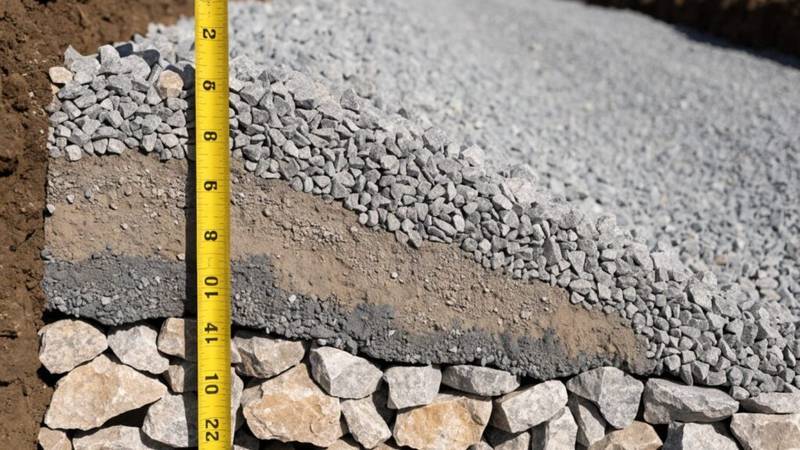
For most residential driveways, 6 to 8 inches total is the recommended depth: 3 to 4 inches of compacted crusher run base topped with 2 to 3 inches of #57 stone surface. Clay soil requires more. Clay soils heave during freeze-thaw cycles, so under the crusher run, place 4 inches of large rock sub-base for a total of 10–12 inches. This is most critical in the Midwest, Northeast and Mid-Atlantic.
If you’re only resurfacing a driveway that’s already in good shape, you need a lot less. If you are adding to an existing driveway, 2–3 inches is typically all that is needed.
The Formula: From Feet to Cubic Yards
Bulk gravel is sold by the cubic yard or by the ton, so first determine the volume:
- To convert the depth from inches to feet, divide by 12. For example, 4 inches = 0.33 feet.
- Multiply length × width × depth to get cubic feet.
- Divide by 27, because there are 27 cubic feet in a cubic yard.
There is also a shortcut that does not involve converting the depth: Volume (yd³) = Length (ft) × Width (ft) × Depth (in) ÷ 324.
Calculate each layer individually, as the materials vary in weight and in many cases in price.
Cubic Yard to Tons Conversion
Many quarries and landscape supply yards in the U.S. charge by the ton, so you will need to convert. The weight depends on the type of stone. Typical figures:
- Pea gravel: ~1.4 tons per cubic yard.
- Crushed stone (#57): ~1.5 tons per cubic yard (the default figure most driveway contractors use).
- Road base / crusher run: ~1.5 to 1.7 tons per cubic yard. The fines fill in between the larger stones, making it denser.
The weight also varies depending on the type of rock. Crushed limestone is about 1.3 tons per cubic yard; granite is heavier, around 1.7. Ask your supplier what conversion factor they are using. It’s a simple question and it helps you stay on track with their billing.
A Worked Example
Suppose you are constructing a new single-lane driveway 12 feet wide and 50 feet long on average soil.
Area: 12 × 50 = 600 square feet
Base layer, 4″ crusher run:
- 600 × 4 ÷ 324 = 7.4 cubic yards
- 7.4 × 1.5 = about 11.1 tons
Top layer, 3″ #57 stone:
- 600 × 3 ÷ 324 = 5.6 cubic yards
- 5.6 × 1.5 = about 8.4 tons
Include 10% for compaction and waste:
- Crusher run: approximately 12.2 tons
- #57 stone: roughly 9.2 tons
Two materials, total order of approximately 21 to 22 tons.
Always Order a Little Extra
Gravel settles a lot under a plate compactor or roller. In particular, crusher run can lose a significant amount of its loose depth when it is compacted. The shortfall is compounded by uneven subgrade, soft spots and spillage along the edges.
A 10% buffer is typical, and 15% is sensible on soft ground or over clay. Suppliers note that a second delivery costs more than a few extra tons would. Leftover stone can go into potholes, drainage swales or around the mailbox post.
Calculating the Cost of Gravel for Your Driveway
With the tonnage known, the cost is easily estimated. Typical rates are $30–$50 per ton picked up, before delivery, and delivery rates are typically $50–$150 depending on distance. Prices differ from region to region and depending on the proximity to a quarry. Rural buyers who are close to an active pit are likely to pay significantly less than buyers in metro areas.
The material for the 22-ton example above will cost approximately $650 to $1,100, not including delivery. A standard dump truck will only hold a certain amount of load, so if you have a big order, it may require more than one truck. When you receive a quote, ask about that.
Pro Tips Before You Order
- Use the right names. Specify the name of the product, such as “#57” or “crusher run.” Words such as “driveway gravel” can have varying definitions at different yards.
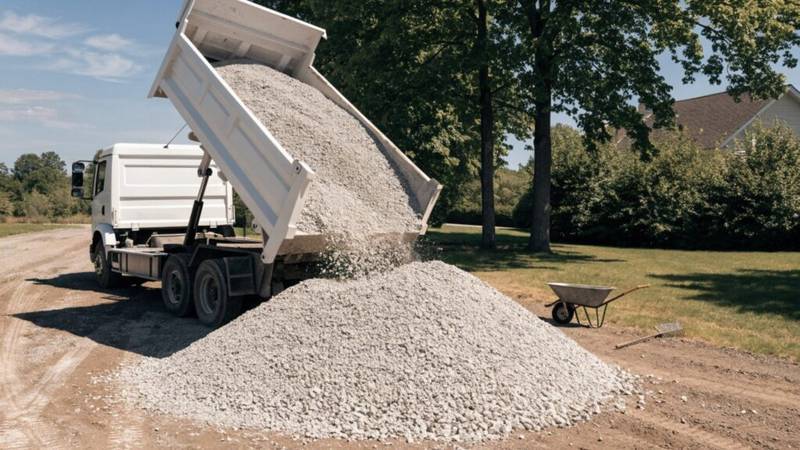
- Pick a drop spot. Get the truck as close to the work area as is safe to dump. It is hard to carry 20 tons of material using a wheelbarrow.
- Lay geotextile fabric. A woven geotextile fabric beneath the base helps to prevent gravel from settling into the soil and decreases the amount of gravel that needs to be added over the years.
- Think about the top. Form the surface slightly higher in the middle so that water drains away from the sides.
FAQ
What is the amount of gravel required for a 2-car driveway?
For a 20 x 25 foot pad that is 4 inches deep, approximately 6.2 cubic yards or 9 to 10 tons of crushed stone will be required. A full layered build with a 7-inch total depth requires closer to 16 tons.
What is the best way to order gravel, by ton or by cubic yard?
Place your order in the unit your supplier quotes in. Work it out in cubic yards first and then convert with the supplier’s weight factor to compare on the same basis.
Can I use pea gravel for my driveway?
Yes, but it’s not usually the best option. Pea gravel is round and will roll and move under tires. Angular crushed stone is more cohesive and retains its shape.
When will I have to add more gravel?
Depending on the amount of traffic, weather conditions, and the quality of the base, most gravel driveways require an inch or two of gravel added every 2–3 years.
Is it necessary to hire a professional to install a gravel driveway?
If you have a short flat driveway, it’s a manageable DIY project with a plate compactor. If your driveway is long, sloped or poorly draining, it’s generally worth it to hire a contractor who has a grading machine.