
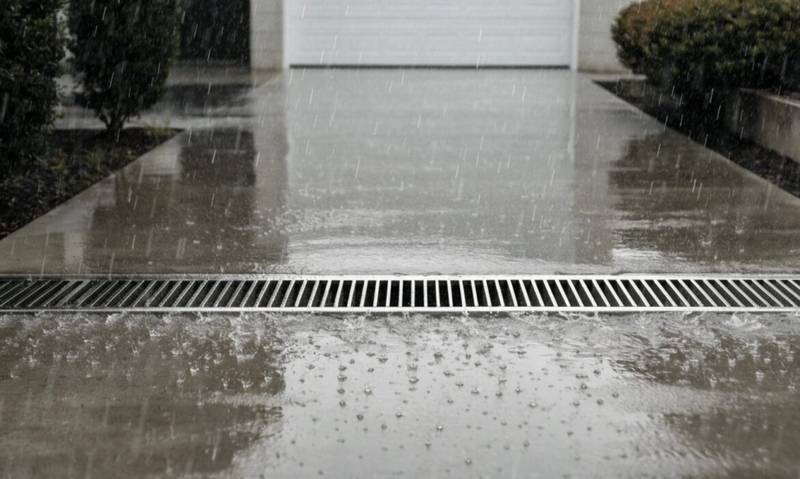
You’re not alone if water runs down your driveway every time it rains and eventually reaches the garage door. One of the most frequent issues with driveways is pooling runoff, and a channel drain is one of the cleanest solutions. Here’s what a channel drain is, how it works, and how to tell whether your driveway needs one.
What Is a Channel Drain?
A channel drain or trench drain is a long, narrow trench with a grate on top that is level with your pavement. A round catch basin collects water at a single point. A channel drain collects water throughout its entire length and conveys it to an outlet at either or both ends. This is ideal for wide driveways where water is coming from a large expanse of pavement instead of a specific spot.
How a Channel Drain Works
It’s a simple process:
- Water is brought to the grate. Runoff is directed over the driveway and through the slots.
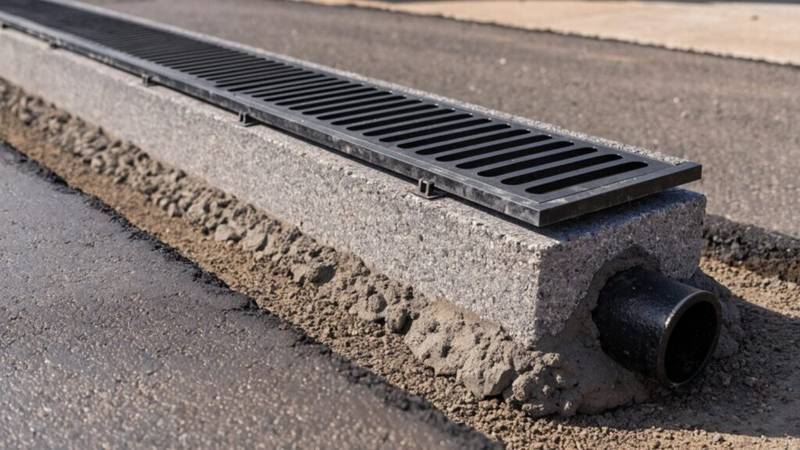
- It is transported in the channel body. The trough is typically constructed of polymer concrete or HDPE plastic and conveys the water across the length of the trough.
- It is carried away by the outlet. Water leaves via an end cap or bottom outlet that is connected to pipe.
- It is discharged from the pipe. This can be a storm drain, a dry well, a rain garden, or a location downhill where the water can safely disperse, depending on your lot and local rules.
The outlet is the one thing people tend to overlook. If there is no place to discharge the water, a channel drain is simply a holding tank, so settle the discharge location before purchasing any equipment. Installers usually place a compacted gravel foundation beneath the drain, typically 4 to 6 inches thick, and then surround the body with concrete to keep it in place under vehicle traffic.
How to Know if Your Driveway Needs a Channel Drain
You don’t need one on every driveway. A slight incline that drains to the lawn might be sufficient. If you see any of these, consider installing one:
- Water flows towards the garage or house. A channel drain is a good idea when water is flowing across a hard surface and needs to be diverted before it reaches a garage floor, foundation or entrance.
- Puddles hang around for a day or more after a storm.
- Edges are eroding. Warning signs include washed out gravel, mud streaks or sediment flowing into the street or a neighbor’s yard.
- Winter ice patches keep returning. Water that is allowed to stand freezes, and repeated freeze-thaw cycles can cause pavement cracking and heaving.
- You have a steep driveway. A steep grade will cause water to flow quickly downhill, and a driveway grade greater than 12% may require additional precautions.
- You’re building or repaving. It is easier to add a drain while you’re building or repaving than to cut one in later.
Channel Drain, French Drain or Catch Basin?
These can be confused easily. On paved surfaces, a channel drain is used to convey surface water. A French drain is underground and is used to drain away ground water or wet soil. If your driveway is sloped towards the garage, you need surface capture, which means you should go with a channel drain. Use French drains only in yard swales or at the bottom of a retaining wall.
A catch basin is appropriate for a low area where water naturally pools. A channel drain typically covers a greater area if the runoff is distributed across the entire width of the driveway.
Choosing the Right Channel Drain
Load rating. Channel drains are rated by the manufacturer for the amount of weight they can support, ranging from foot traffic to heavy trucks. A driveway should have a drain that is rated for vehicles. A drain for a commercial site will need to be much more robust than a drain for a domestic patio. If delivery trucks or RVs frequently drive over yours, go heavier.
Grate material. Galvanized steel, stainless steel, and cast iron are the best materials to support cars. Plastic grates are less expensive but may break under heavy loads. Slot and wedge-wire grates are stylish, but they can require frequent upkeep to function.
Width and length. Select a drain that is as wide as the area water is crossing, like the garage entrance. A 4″ wide channel is the most common size for residential projects.
DIY or Hire a Pro?
It’s easy to install a drain when you’re building a new home. Retrofitting one is more difficult. If the driveway is already in place, it may be necessary to saw-cut the concrete prior to excavation. A typical retrofit is as follows:
- Mark the drain path where water accumulates.
- Cut and remove pavement with a saw.
- Dig the trench and compact a gravel base.
- Adjust the channel to the proper height and slope.
- Install the outlet pipe.
- Pour concrete around the body and then set the grate.
Here, little mistakes count. In one UK instance, a 3m run was set 5mm too high at one end, which led to pooling until it was replaced.
If the run is more than about 20 feet, if more than one outlet is required, if rebar or wire mesh is used in the slab, or if local code mandates a permit for a storm connection, consider hiring a professional. It is usually necessary to obtain approval before connecting to a street gutter or storm sewer, so check with your municipal public works office first. Installed prices can vary significantly from region to region, pavement type to pavement type and run length to run length, so obtain at least two or three local quotes.
Keeping It Working
Channel drains only function when water is able to enter. Remove leaves, grit and debris from the grate every few months and after big storms, particularly in the fall. Hose the channel once or twice a year and ensure water is flowing freely at the outlet. In cold climates, remove ice and snow from the grate to allow melt water to flow in.

FAQ
If my driveway slopes away from the house, do I need a channel drain?
Not always. If water consistently drains into your yard and doesn’t puddle, you may not need a drain. It can be helpful when the slope is too low, when water is flowing into the street, or when erosion is occurring.
Is a channel drain suitable for carrying cars and trucks?
Yes, provided it has a vehicle-rated grate and is set in a suitable concrete surround. Review the manufacturer’s load rating and ensure it is compatible with the heaviest vehicles that will be crossing it.
Where will the water go?
Typically a storm drain, dry well, rain garden, or a downhill location where it can disperse safely. Local rules may differ and some towns prohibit connection to the street or storm sewer, so check before planning.
Can I install it myself?
A competent DIYer can handle short runs on new or unpoured surfaces. Existing concrete or asphalt cutting, storm system connection and slope adjustment are best left to a pro.