
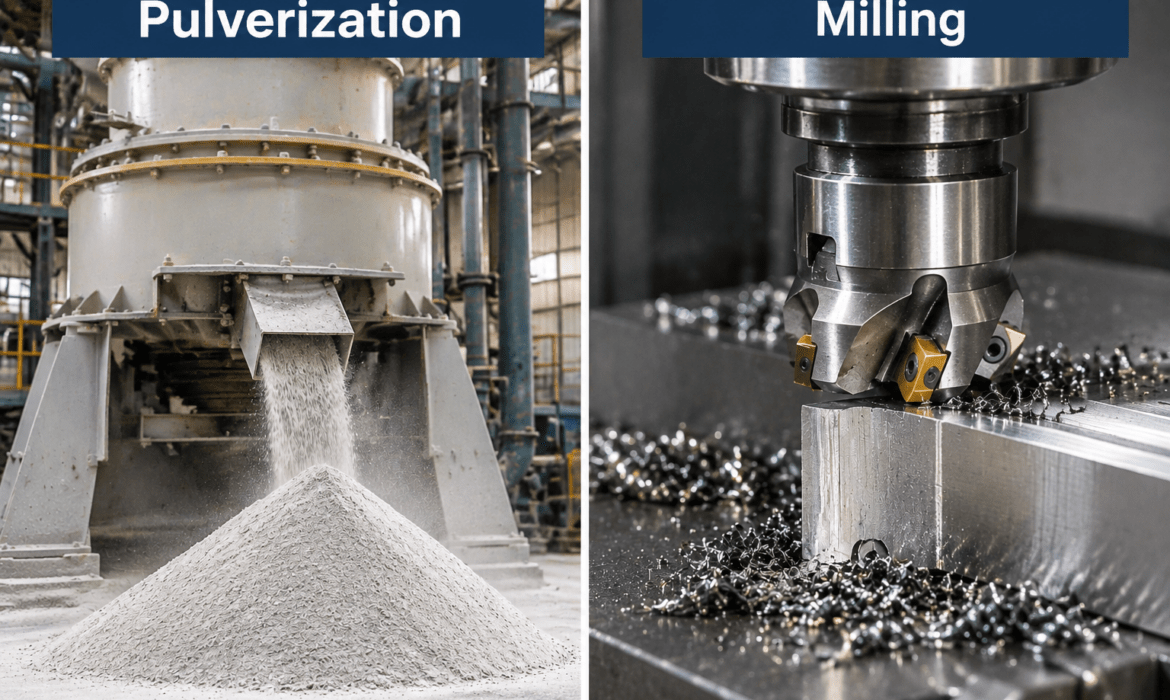
In the manufacturing sector, pharmaceuticals, food processing, chemicals, mining and other sectors, minimizing the size of solid materials is a significant aspect of production. Two commonly used terms for this process are pulverization and milling. They are not precisely the same although they are sometimes used interchangeably.
Both processes convert large materials into smaller particles, although they are different in their processes, equipment, particle sizes and uses. Understanding the distinction between pulverization and milling can assist companies in selecting the appropriate size-reduction technique to achieve higher efficiency, product quality, and cost management. Similar material processing concepts are also important in industries that work with Construction materials and aggregate preparation, where the right approach helps improve performance, durability, and overall project outcomes.
What Is Pulverization?
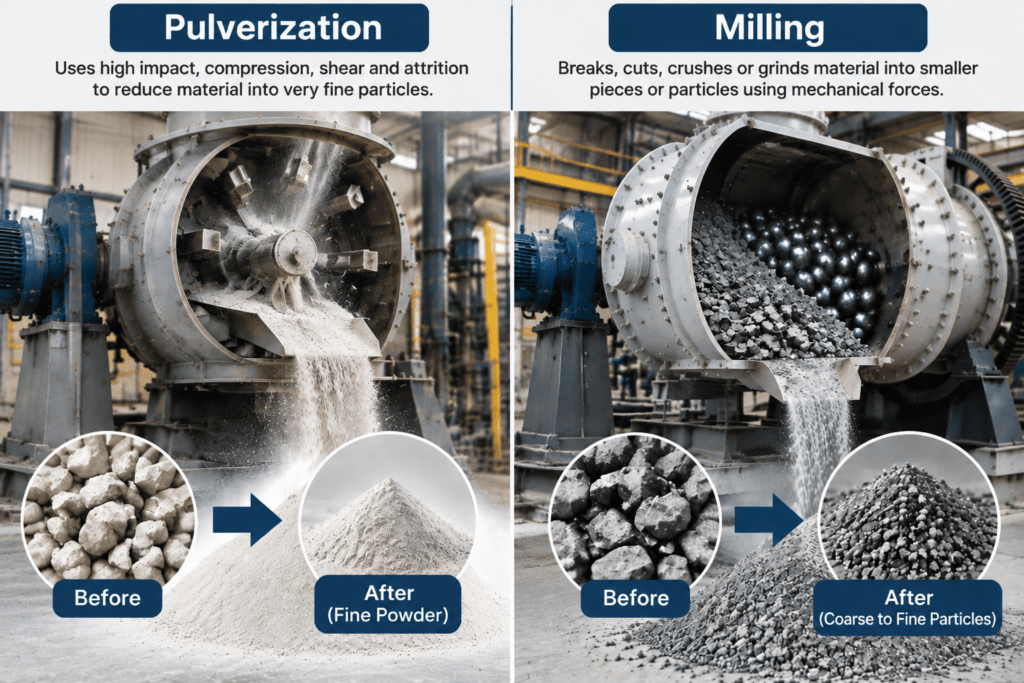
Pulverization is the process of reducing a solid material into very fine particles, powder, or dust. The primary goal is usually to achieve a significantly smaller and more uniform particle size.
There are various mechanical forces that may be used in pulverization, such as impact, compression, shear, and attrition. Depending on the properties of the material and the required final particle size, specialized equipment is chosen.
The process is usually applied in cases where very fine material is needed. As an illustration, pharmaceutical substances might require to be ground to enhance their dispersion or formulation. Likewise, minerals, chemicals, pigments, and some food additives may be pulverized prior to further processing.
What Is Milling?
Milling is a more general size-reduction process where material is broken, cut, crushed or ground into smaller pieces or particles by mechanical means. Milling does not necessarily produce an extremely fine powder. The end particle size may range from relatively coarse pieces to extremely fine particles, depending on the equipment and process settings.
Popular milling machines include hammer mills, ball mills, pin mills, bead mills, roller mills, and other specialized machines. The different types exert varying forces on the material.
Milling is commonly applied across various industries. Millers can process grains into flour, and pharmaceutical manufacturers can mill active ingredient particles to achieve the desired size. Milling is also used to prepare materials for mixing, separation, or further processing. Similar material preparation concepts are important in construction applications, where properly processed asphalt materials and aggregates help support durable surfaces such as Driveway paving projects.
Pulverization vs. Milling: Key Differences
The primary distinction between the process of pulverization and milling is the extent and purpose of size reduction. Pulverization typically means the creation of very fine particles, whereas milling is a broader concept that encompasses a wider range of particle sizes and processing goals.
Milling may be viewed as a general term for several mechanical size-reduction processes. Pulverization is a common term used to describe an intensive grinding process that results in the creation of a powder-like substance.
There can also be differences in equipment selection. When a material only needs to be reduced to a moderate particle size, a standard mill might be adequate. In cases where a fine and uniform powder is required, specialized pulverizing machinery might be necessary. Similar attention to material performance and durability is important in construction environments, especially when developing long-lasting surfaces for Commercial paving applications that experience regular traffic and heavy use.
The other difference is the intended outcome. Milling can be aimed at achieving a desired particle size for downstream processing, whereas pulverization focuses on achieving the highest possible fineness and powder uniformity.
How Do the Processes Work?
Pulverization and milling are both processes that involve mechanical forces to separate materials. The distinction is primarily in the way the forces are exerted and the fineness of the final material.
In milling, materials can be subjected to impact, compression, shear, or attrition. To illustrate, a hammer mill involves the use of hammers that move fast to hit and shred particles. The roller mill is a compressor that uses rotating rollers to compress the material. A ball mill is a type of mill that relies on the impact and friction of grinding media.
Similar principles can be used to pulverize, but it is usually set up to produce much finer particles. The high speed of impact, high friction, and repeated grinding can gradually decrease the material until the required fineness of the powder is achieved.
The final particle size can be influenced by factors like feed size, material hardness, moisture content, machine speed, grinding time, and screen or classifier settings. These factors need to be properly controlled to ensure consistent results.
When Should You Use Milling?
Milling is the better choice when you need controlled and flexible Particle-size reduction. It is suitable for applications where the material does not necessarily need to become an ultra-fine powder.
You may choose milling when:
- The size of the target particle is coarse to fine.
- You require a particular and regulated distribution of particles.
- The material should be ready to be mixed, blended or processed.
- High production capacity is important.
- Various materials need various milling processes.
- You need an economical and versatile size-reduction solution.
For example, the processing of grain is usually based on milling to yield flour and other products. In the pharmaceutical industry, milling may be used to create particles with the desired properties to be used in the production of tablets or other formulations.
The right mill is based on the material properties, volume of production, the size of particles needed and other process requirements.
When Should You Use Pulverization?
Pulverization is best suited when extremely fine particle sizes are imperative to the application. Making a fine powder may enhance surface area, dispersion, or allow a material to be more easily incorporated into another product.
Pulverization may be preferred for:
- Making extremely fine powders.
- Processing pharmaceutical ingredients.
- Breaking down hard or brittle materials to small particles.
- Mineral and chemical preparation to be used in downstream.
- Improving material dispersion.
- Expanding surface area to some applications.
The process must be chosen wisely since the generation of unnecessary fine particles may lead to higher energy usage, processing time, heat generation and equipment wear.
Factors to Consider Before Choosing
Choosing between pulverization and milling should begin with the material and the desired end product, rather than simply the equipment name.
Consider the hardness, toughness, brittleness, moisture content, heat sensitivity, and abrasiveness of the material. These properties determine how easily the material can be reduced and which mechanical force will work best. Similar considerations are important in construction applications, where material quality and proper evaluation play a key role in long-term performance and effective pavement maintenance.
The volume of production, energy used, equipment upkeep, risk of contamination, temperature regulation, and operating expenses must also be considered. Sanitation and purity of products are especially significant in industries such as pharmaceuticals and food processing.
An effective size-reduction process must strike a balance between particle size, throughput, product quality, energy efficiency, and operating cost.